Google Is Changing Ad Measurement: Why First-Party Customer Data Matters More Than Ever
Google is rebuilding ad measurement around first-party customer data in 2026. What changed — Data Manager, Enhanced Conversions, Data Strength Uplift, Meridian — and what every advertiser should connect now.
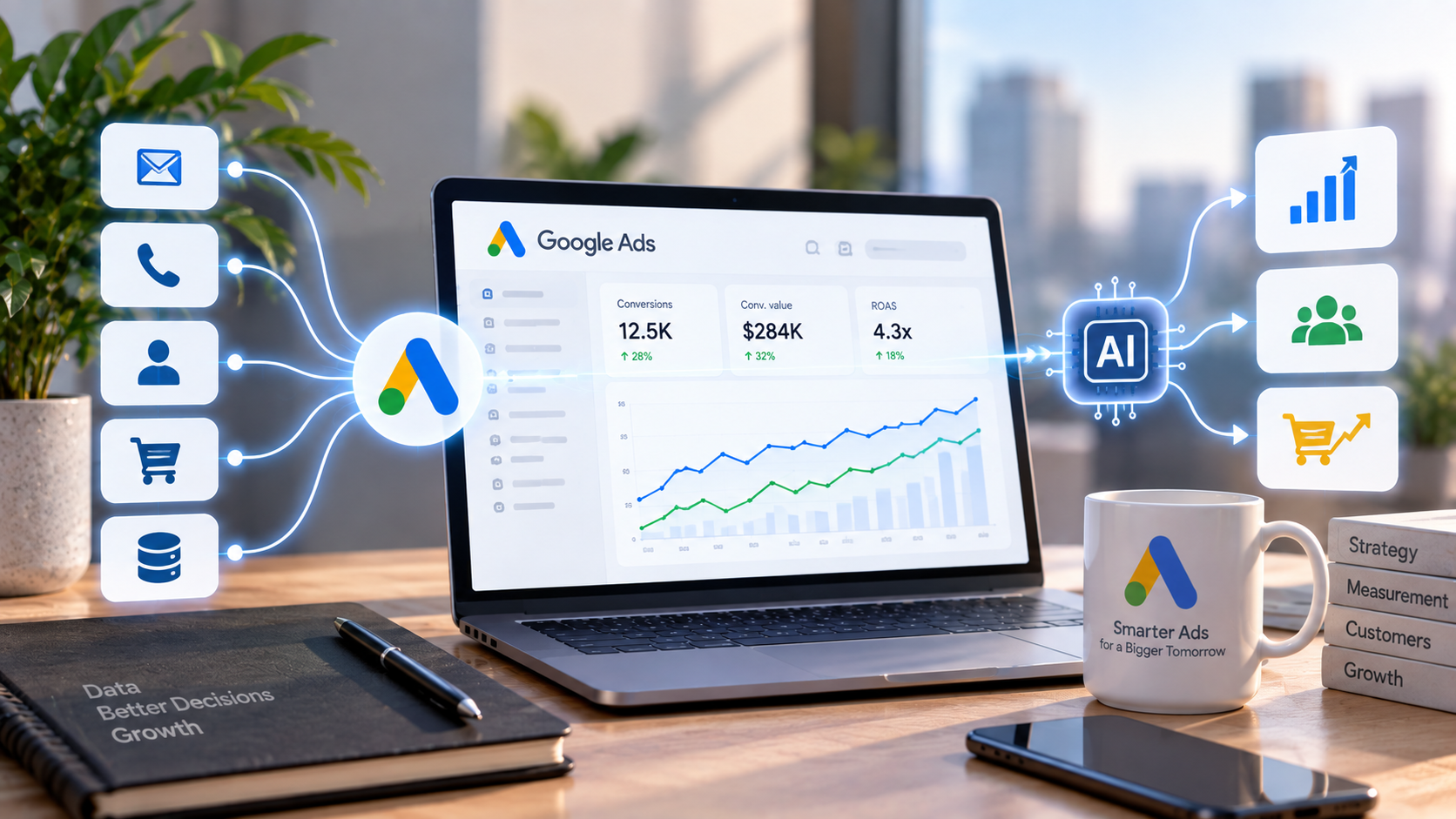
Google Ads optimization now runs on AI more than ever: systems decide targeting, bidding, and messaging from the signals they receive. That shifts the core question from “how much do we spend?” to “how good is the data feeding the system?”
In September 2026, Google reinforced its measurement stack around first-party data: Data Manager integrations, the Data Strength Uplift metric, expanded Enhanced Conversions, and Meridian upgrades. This article explains what actually changed, what it means in practice, and what to do this week — keeping Google's official announcements clearly separate from Rozanah's analysis.
What is changing in Google Ads measurement?
On September 10, 2026, Google announced measurement-suite updates for driving profitable growth with new data and measurement tools. The direction is singular: a stronger data foundation to fuel AI, multiple signals to see the full picture, and causal proof of real commercial impact.
| Development | What changed? | Why it matters? |
|---|---|---|
| First-party data | Unifying signals across platforms via Data Manager | AI fuel: sharper signals mean better decisions |
| Data Manager | Direct Analytics and DV360 integration plus a universal API | Manage and activate data from one place instead of fragments |
| Data Strength Uplift | A new metric counting extra conversions recovered by your data setup | Links data investment to a measurable outcome |
| Enhanced Conversions | Expanded coverage and unified settings during 2026 | More accurate conversion measurement through secure customer-data matching |
| Meridian and measurement | A measurement model analyzing each channel's contribution to outcomes | Causal proof of impact instead of reports alone |
Why does first-party data matter more in the AI era?
The logic is a chain: better customer data → sharper conversion signals → truer measurement → stronger optimization inputs → sounder business decisions. But it is a chain of probabilities, not guarantees: AI systems are only as useful as the quality, relevance, and accuracy of the signals they receive.
What counts as useful first-party data?
Not all data is equal. Useful data connects advertising to a real commercial outcome:
- Customer email address.
- Phone number.
- Purchase data: product, value, and date.
- Qualified lead information.
- CRM outcomes: customer status and stage.
- Offline sales: deals closed outside the website.
- Subscription and sign-up outcomes.
- Customer value where appropriate.
Enhanced Conversions: what advertisers need to understand
Enhanced Conversions are a way to measure more accurately: when a customer buys or submits a form, their basic details (such as an email address) are sent encrypted (SHA256) to match against Google accounts. The practical result: conversions credited to the campaigns that truly earned them — and smarter bidding decisions.
The feature covers two cases:
- Enhanced Conversions for web: measuring sales and events that happen on the website.
- Enhanced Conversions for leads: measuring off-site deals originating from website customers — Google's recommended replacement for legacy offline conversion import.
- Correct implementation plus customer-data and consent policies are preconditions for risk-free benefit.
The biggest mistake: measuring clicks instead of business outcomes
Clicks are not customers. Form fills are not always qualified leads. Leads are not necessarily revenue. And revenue is not always profitable revenue. An account optimizing around the wrong level buys illusion by the numbers.
| Stage | What it means? |
|---|---|
| Click | Initial interest — no commercial value by itself |
| Conversion | A recorded event — possibly valuable or worthless |
| Qualified lead | A genuine opportunity worth pursuing |
| Customer | A closed deal and realized revenue |
| Revenue | Money coming in — before costs |
| Profit / value | The bottom line the business lives on |
What should you connect to Google Ads?
- Website conversion tracking.
- Enhanced Conversions.
- CRM data with consistent cross-system identifiers.
- Offline conversion data.
- Qualified-lead status.
- Revenue and value data.
- Correct attribution and setup.
- Privacy and consent requirements.
What should you review in your account now? 7 steps
- Audit current conversion actions: list everything counted as a conversion — to find what deserves to stay and what must go.
- Identify the conversions that truly matter: what moves revenue stays an optimization target; the rest is for monitoring only.
- Check Enhanced Conversions status: enabled? Web or leads? — it is the gateway to measurement accuracy.
- Review first-party data availability: what do you actually hold (email, phone, purchases) and what is missing?
- Connect CRM and offline outcomes where appropriate: to close the loop between ad and deal.
- Check conversion values: do they reflect real commercial value or symbolic numbers that mislead bidding?
- Document a baseline and monitor change: record current measurement indicators to judge later improvement objectively.
What NOT to do
- Don't send every available customer field just because it exists: send only what serves measurement.
- Don't optimize around low-value conversions: you'll attract more of them.
- Don't treat a higher reported conversion count as automatic growth: verify quality.
- Don't ignore customer-data and privacy policies: violations cost more than any uplift.
- Don't change several measurement systems at once without a baseline: you'll never know what worked.
How do you know your measurement improved?
| Signal | What to look for? |
|---|---|
| Conversion coverage | Are the important conversions actually measured? |
| Conversion quality | Are qualified outcomes represented in the data? |
| Match and measurement quality | Is useful first-party data reaching the system correctly? |
| Lead-to-customer rate | Are reported leads becoming real customers? |
| Revenue attribution | Can advertising be connected to business value? |
| Decision quality | Are campaign decisions becoming more reliable? |
What does the new Data Strength Uplift metric mean?
The new Data Strength Uplift metric answers one question: how many extra conversions did your first-party data setup recover — conversions that would otherwise have been lost to measurement? It measures the quality of measurement itself, not campaign performance — telling you whether your data investment is actually paying off.
Google also cites indicative figures from its internal data: 26% average incremental-ROAS uplift for advertisers connecting app and offline data, 11% more Search conversions for Enhanced Conversions users, and 14% conversion uplift via the tag gateway — over 20% for Demand Gen campaigns. These are Google's figures in their contexts — not a Rozanah benchmark and not a promise of similar results.
When Click Data Isn't Enough
When a customer sees your ad on Google, then notices your brand on YouTube, then buys in-store — which channel deserves the credit? Click data alone can't answer that, because the journey spans multiple channels.
Meridian is a measurement model from Google that helps businesses analyze how different marketing channels contribute to business outcomes, especially when the customer journey spans multiple channels. Put simply: instead of asking “which channel showed up last?”, ask “which channel actually drove the sale?” — and that is the answer that guides the budget wisely.
The measurement stack you should build
This stack is the article's most important takeaway:
- Accurate conversion tracking.
- First-party data.
- Qualified outcomes.
- Revenue and business value.
- Attribution: knowing which channel was associated with the conversion.
- Incrementality and testing where appropriate: proving what a channel actually added, not just what it touched.
- Strategic measurement and mix models (MMM) for larger organizations: a view across the full budget.
Conclusion
Competitive advantage is no longer about getting more clicks. It is about feeding advertising systems better signals about which users, actions, leads, and customers actually matter.
The methodology in six steps: measure → connect → qualify → feed → evaluate → improve. Start with measurement — everything after it is built on top.
Do you really know what Google Ads counts as a successful conversion in your account?
Request a measurement review covering: conversion tracking, Enhanced Conversions, lead-quality signals, conversion values, and measurement structure.
Request an ads-measurement review to learn whether your account measures real outcomes — or merely easy events.
Sources
- Google announcement: driving profitable growth with new data and measurement tools (September 10, 2026)
- Google Ads Help: about Enhanced Conversions
- Google Ads Help: updates to your Enhanced Conversions settings
- Google Ads Help: using Data Manager with Enhanced Conversions for leads
- Google Ads Help: Enhanced Conversions best practices
The facts above come from Google's official sources. The audit steps and recommendations are Rozanah's analysis from campaign-management experience — not official Google statements.