Google Ads Is Changing in September 2026: What AI Max Means for Advertisers and Businesses
Google is auto-upgrading eligible Search campaigns to AI Max in September 2026. What changed in matching, creative, and language targeting — and a practical audit checklist for every advertiser.
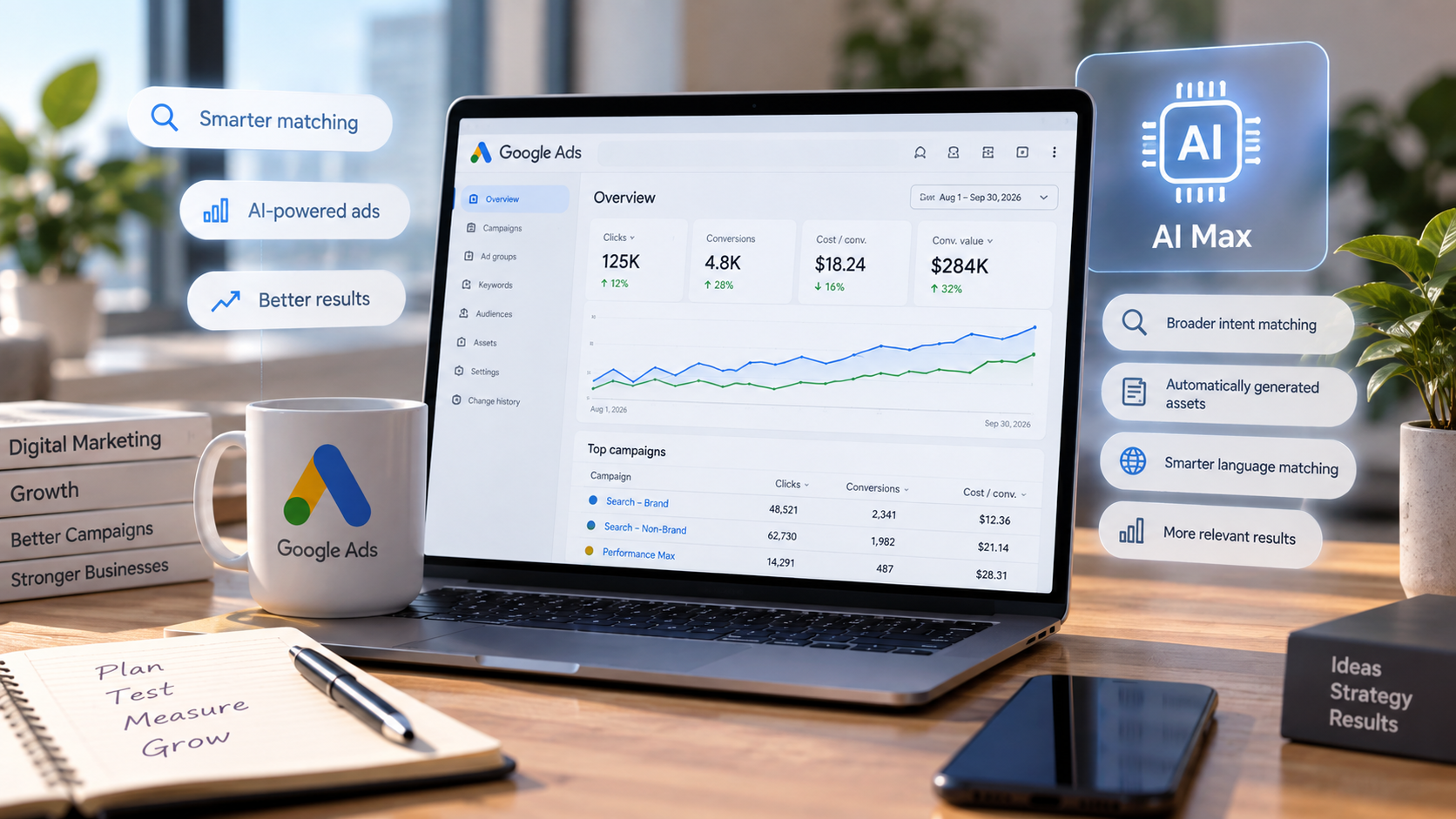
In September 2026, Google began progressively auto-upgrading certain Search campaigns to AI Max: campaigns using campaign-level Broad Match or Automatically Created Assets. Your results could shift without you touching a single setting.
If you run Google Ads — in any market, in any country — only one question matters: is my account affected, and what should I review this week? This article answers both directly, and keeps Google's official facts clearly separate from Rozanah's practical recommendations.
What changed in Google Ads?
Google announced the September migration of two Search campaign groups to AI Max: campaign-level Broad Match campaigns (the whole campaign runs on broad logic) and standalone Automatically Created Assets campaigns (headlines and descriptions generated from your site content). In parallel, campaign-level language targeting was removed.
What happens to your campaign after migration?
Your campaign does not become a new type. The AI Max layer activates with defaults that depend on the campaign's origin: Broad Match arrivals migrate with Text Customization and Final URL Expansion off and Search Term Matching on, keeping existing brand lists. Standalone ACA arrivals migrate with Text Customization on.
| Change | Who is affected? | What happens? | What to review? |
|---|---|---|---|
| AI Max migration | Selected Search campaigns | The AI Max layer activates inside your existing campaign | Migration status and Change History |
| Search Term Matching | Migrated campaigns | Broader understanding of intent beyond your added keywords | Search-term reports, weekly |
| Text Customization | Depends on campaign origin | AI-generated ad copy | Current asset quality and text guidelines |
| Final URL Expansion | When enabled | Traffic directed to your most relevant pages | Eligible pages and URL exclusions |
| Language targeting | All Search campaigns | Automatic matching by ad and query language | Assets in every language and page language |
What is AI Max?
Google is explicit on a widely misunderstood point: AI Max is not a new campaign type. It is an optimization layer inside your existing Search campaigns, giving Google more room in intent matching, copy generation and asset improvement, landing-page selection when Final URL Expansion is on, and AI-driven relevance.
Is your Google Ads account affected?
Not every campaign is included. Check your actual account:
- Campaign-level Broad Match: candidate for September migration.
- Automatically Created Assets / Text Customization: the second included group.
- AI Max notifications inside the account.
- Change History: did a migration actually happen, and when?
- Old Search campaigns untouched for years.
- DSA campaigns: read the dedicated section below before drawing conclusions.
- Multilingual accounts: the language-targeting change applies regardless of migration.
- Conversion-tracking accuracy: expansion without clean tracking is spend without a compass.
Don't assume all your campaigns migrated — or that nothing changed. Inspect each campaign individually.
Why does the language-targeting change matter?
Campaign-level language settings are gone; ads now match on ad language, query language, and user signals, with intelligent prioritization of the best-fit ad group. This matters for any multilingual account: customers searching in Spanish («abogado cerca de mí») and English («immigration lawyer near me»), with mixed-language queries — sometimes within a single session.
Review these five areas:
- Creative quality in every language your account runs, each judged on its own.
- Campaign and ad-group structure: does it separate languages to serve smart prioritization?
- Landing-page language and its match with ad language.
- Search-term reports to catch language leakage early.
- Settings that previously relied on language targeting as a separation tool.
What does AI Max mean for advertisers?
- Less manual control per formulation: your keywords are a starting point, not hard boundaries.
- Landing pages decide the outcome: speed, clarity, easy contact, mobile.
- Accurate tracking is the price of admission: tracking pageviews alone misleads the system.
- Clear messaging plus search-term discipline: genuine offers stand out; exclusions protect the budget.
Three quick examples:
- Local services: you'll capture formulations like «plumber near me» — the opportunity is coverage, the risk is unserved areas. Exclude them in advance.
- E-commerce: you'll discover new seasonal gift queries — the opportunity is demand, the risk is margin. Fix return-on-spend tracking first.
- B2B: expansion will mix consumer queries with decision-maker queries — the opportunity is reach, the risk is spend on the unqualified. Negative keywords are the answer.
What should you do now? A 7-step checklist
- Confirm migration status: inspect each campaign's settings and Change History — know what actually changed before deciding anything.
- Audit conversion tracking: calls, forms, and orders recorded once, with correct values — the system will scale spend on this data.
- Review search terms (30–90 days): promote winning queries to keywords; pre-build exclusions for waste patterns.
- Update exclusions: negatives plus brand and URL lists — including careers pages and privacy policies.
- Audit landing pages: mobile speed, headline-to-ad match, visible contact path, language fit.
- Review assets in every language: improve existing headlines instead of literal translation; set text guidelines and tone.
- Record the baseline: log the last 4–8 weeks of metrics so you judge impact in numbers, not impressions.
What should you avoid?
- Don't rebuild campaigns immediately: migration preserves performance history; rebuilding restarts learning from zero.
- Don't raise budgets blindly: first confirm the new spend goes to qualified queries.
- Don't judge after a few days: new matching logic needs a stabilization period.
- Don't switch to set-and-forget: the weekly search-term review is the price of expansion.
How do you measure success?
| Metric | What it tells you |
|---|---|
| CTR | Ad appeal only — not result quality |
| Conversion rate | Ability of traffic to become customers |
| Cost per qualified lead | Customer acquisition efficiency |
| ROAS | Financial return per unit of spend |
| Lead quality | Real commercial value of acquired customers |
| Revenue | The final commercial outcome |
What about DSA?
Google delayed automatic Dynamic Search Ads (DSA) migration to February 2027. Don't confuse it with the September 2026 migration — DSA campaigns are outside the current change.
Conclusion
September 2026 opens a new phase of Search advertising. Stubborn resistance leaves you behind competitors; blind adoption leaves your budget to settings you never reviewed.
The right methodology in five steps: audit → prepare → measure → test → optimize. Start today.
Is your account ready for AI Max?
Request a structured review of your ad account covering: AI Max settings, conversion tracking, campaign structure, search terms, negative keywords, and landing pages.
Request an ad-account review and find out where you stand — measured in numbers, not gut feeling.
Sources
- Google Ads Developer Blog: migrating campaign-level Broad Match and Automatically Created Assets to AI Max (August 2026)
- Google Ads Help: setting up AI Max for Search campaigns
- Google Ads Help: language targeting and the September 2026 changes
- Google Ads Developer Blog: delaying automatic DSA migration to February 2027 (June 2026)
The facts above come from Google's official sources. The audit steps and recommendations are Rozanah's analysis from campaign-management experience — not official Google statements.